

I don’t typically write about the MVP race, especially when the team I cheer for is middling.
But Yordan Alvarez is putting up a season for the ages with 64 games left in the Astros regular season, and it’s clear to me that he is the American League MVP at this point of the season.
Let me explain.
The Numbers
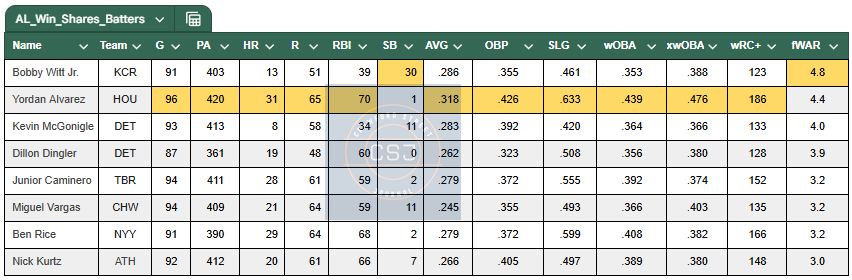
Yordan leads in every category, some by miles, except for stolen bases and fWAR.
This also shows how much impact defense has on the fAR metric, especially for an elite shortstop.
The wonders of AI brought me this estimate:
Elite defenders (e.g., premium glove at SS/CF/C): +15–25+ fielding runs can add 1.5–2.5+ WAR, or 20–50% of total fWAR for a 4–6 WAR player.
There’s really no other explanation for why Witt, as good as he is, has more fWAR than Yordan and you could argue it’s remarkable that it’s as close as it is, with Alvarez having only played 120 innings in the field this season.
I’ve been fairly critical of the fWAR metric over the years and this is why I came up with Win Shares.
But the criticism is not because of the way fWAR accounts for defense - defense is important - but rather the metric doesn’t measure what the name says it measures.
So I decided to use it to come up with a metric that does measure what the name says - Win Shares.
The Win Shares Methodology
It’s really quite simple.
Win Shares Formula:
Sum of fWAR for each player on the team/team wins = fWAR per win.
Players fWAR/fWAR per win (step 1 result) = Win Shares
Note: The sum of win shares for all players on a team should equal the number of wins a team has.
Note: I sum each individual player’s fWAR on a team and not the team total, because rounding is a thing on fangraphs.com.
The Results
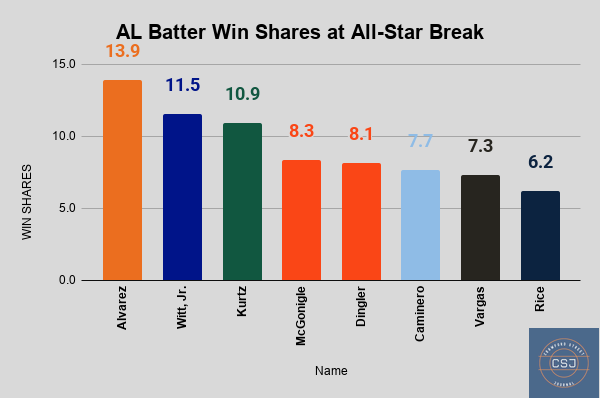
Yordan has been worth 2.4 more wins than Witt, Jr., and 3.0 more wins than Kurtz.
Problems with Win Shares
As you can tell by the chart above, there’s a tendency for players on teams with fewer wins to be favored by this formula. Those teams generally have lower team fWAR overall, so the denominator is smaller.
On the flip side, by nature of being really good on a “not so great” team, these players are inherently carrying more of the load, even though that load is smaller, in general.

For example, while both are extremely valuable, I’d argue that Yordan is more valuable to the Astros than Ben Rice is to the Yankees.
The Yankees may survive a Rice injury, as they are (kind of) doing with Judge out right now.
The Astros would be less likely to survive a Yordan injury.
Summary
This is a fun tool, but not the be-all and end-all, and I recognize it has limitations.
Any ideas for improving it are welcome.
In fact, if I were voting, it would be Yordan, then Caminero, then Witt, Jr.
Instead of a definitive answer, think of it as one more box checked. Yordan leads in most of the significant categories AND he adds more wins to his team than any other player by this metric.
Thanks for reading!