


If you’ve read enough of my ramblings, you likely know that one of the things created here is projected standings, which are based on my own proprietary criteria that includes run differential and actual wins and losses.
While the Pythagorean formula works “pretty good” recent history has shown the formula I use to be more accurate.
I don’t say that to brag - I’ve been wrong plenty - but rather to explain why I use the formula instead of the Pythagorean.
For example, this past season, the formula I used was closer on 26 win totals and tied on 4, and was outperformed by the Pythag on exactly 0 win totals.
In the background, I also keep what I call my MLB Regression Report for all 30 teams.
This report compares actual wins to Pythagorean Expected Wins and MLB Regression Report Expected Wins (MLB Regression Rpt xWins below).
The result, in the far right column, is the number of wins a team is over (+) or under (-) their expected wins.
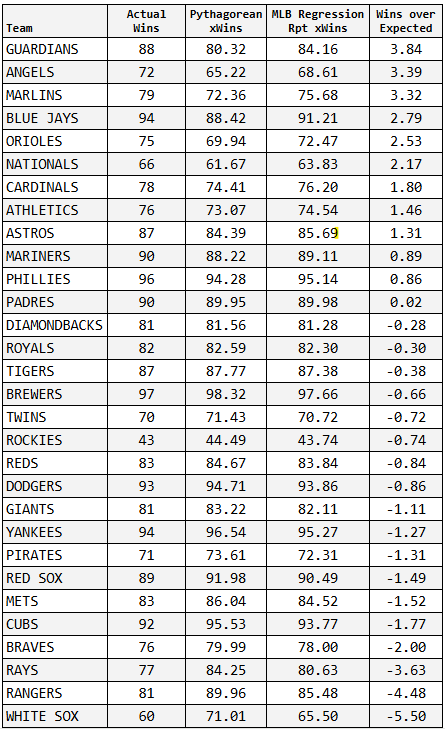
One way to think about this number is as a “luck” report: teams with positive numbers are likely to negatively regress towards 0, and teams with negative numbers are likely to positively regress towards 0.
For example, the Guardians won 88 games with a negative run differential and finished 3.84 games better than expected.
If everything is the same this year, we would expect them to win 3.84 games less and finish with 84 wins.
Great, What’s Your Point?
I use this report in several ways: first, as a starting point for the coming season, and second, as an in-season tool to judge teams.
A couple of examples:
The Nationals won 66 games last season and were horrid, but the report above shows they actually overperformed (in terms of wins) and should have won only 64. Given their offseason moves (trading for prospects, generally) and change in leadership/youth movement, they are likely to move what stars they have before the trade deadline rather than keep them and try and win a few extra games in 2026. Yet, at least one early win total for the Nationals shows 66.5, which I think is high. In effect, the report provides a 2.17-game “head start” to the Nationals’ 2026 season, meaning I see a 64-win team with a high probability of finishing the last two months without their best players. I would expect fewer than 66.5 wins.
In season, I use the report to gauge which teams may come back to the pack (or fall farther behind). The Astros were consistently positive on this report throughout 2025, meaning they were winning more games than expected. That finally caught up to them, and they faded down the stretch, yet still finished 1.31 games higher than expected.
How’s That Help Me in 2026?
I’ve already projected the Astros to around 78 to 82 wins as it stands, but that doesn’t add in the players that will join the team in-season, whether from trades or the minor leagues. With their early win total set at 86.5, I find no value on either side and think that’s a fair number. They will need a relatively big addition before I consider them a contender.
One interesting team is the Rangers, who underperformed by the second-most games in the entire MLB. This was largely due to their elite run prevention. With the Rangers’ win total set at 81.5, it’s not difficult to see them surpassing that number, if for no other reason than sheer luck and perhaps the Astros, Angels, and Athletics taking a step back.
Also, I would expect the White Sox to win around 65 games and those folks setting the win totals agree, setting their number at 65.5. The Pale Hose are accumulating talent, slowly, but surely, and should improve in 2026.
As mentioned, expect the Guardians to step back from 88 wins, though the 80.5 set by the books seems like a drastic one. I can see them dropping to around 83 wins.

Known Unknowns and Unknown Unknowns
Baseball seasons can be weird. The Guardians were outscored and won 88 games. The Rangers gave up the fewest runs in the league and won 81. Be careful and consider injuries that you know about (Astros starting pitchers) and injuries you don’t know about (Yordan’s various maladies).
For me, I see the Nationals regressing and the White Sox moving forward, but given the current win totals, one is clearly more appealing than the other.
I plan to share the report more often in 2026 because I think it’s valuable, especially late in the season.