

I’ve done several projections for the upcoming season, but the one below is the most comprehensive to date and uses the latest position-by-position projections from fangraphs.com.
There’s no guarantee that the team with the most fWAR will win, as “Wins Above Replacement” doesn’t actually mean wins above replacement as we’ve discussed before, but nonetheless, it’s a starting point.
I’ve tried to estimate wins based on a team’s total fWAR, but it doesn’t work that way. While teams like the Astros and Mariners hover around the .45 fWAR per win, teams with fewer wins don’t (the Angels won 72 games with 13.3 fWAR in 2025, for example), so applying the “league average” (.41 in 2025) yields useless results.
So, what we’re left with is the current projected fWAR for each team, which should be used as a guideline, not a final answer.
With that huge caveat, here we go.
Catcher
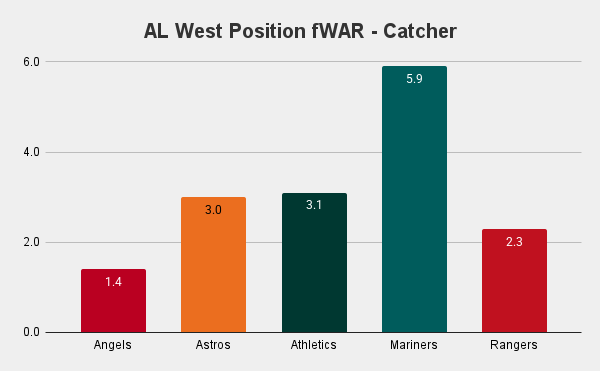
Perhaps the least surprising position of all on the list for some, no one this side of Washington state can sanely project another 62 HR season from Cal Raleigh.
That said, he’s still the class of the position fWAR-wise in the division.
The numbers project a 1 increase in fWAR for Yainer Diaz, from 1.6 to 2.6.
1st Base
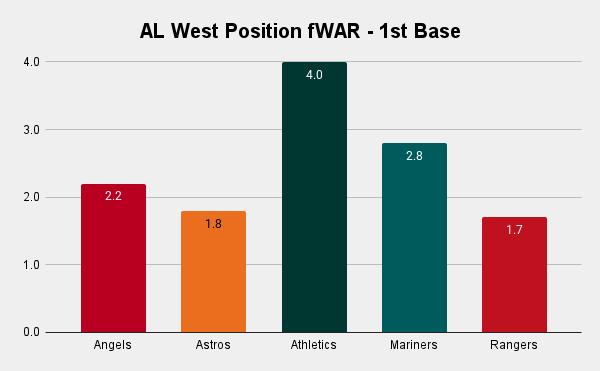
Reading the offseason writings of beat writers writ large, apparently, there is still the chance of a trade of Christian Walker or Isaac Paredes, so this is the most likely position to change significantly for Houston.
Either way, Nick Kurtz leads the division, but with the Astros being near the bottom of the division, there’s a need for improvement, and the move from 1.1 to 1.5 for Walker year over year is not nearly enough.
2nd Base
Jose Altuve will return to being the primary second baseman, declining defense and all, with rumblings of Parades “taking some grounders” or “seeing time” at second, depending on who you believe/read.
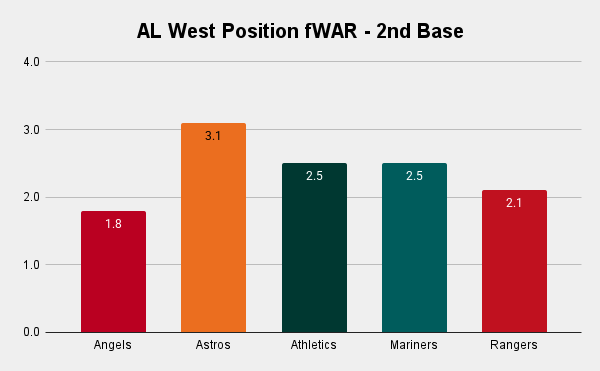
All in all, it’s one of the weaker positions in the division, but an interesting one for the Astros.
Fangraphs projects fewer plate appearances for Altuve as part of a second base by committee, including contributions from Nick Allen, Paredes, Brice Matthews, and Shay Whitcomb.
Shortstop
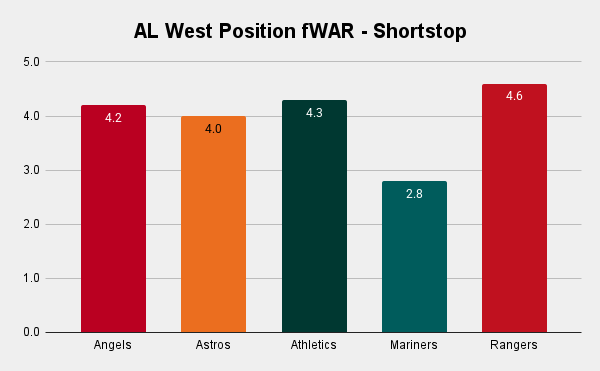
There’s no question who will be manning this position as long as healthy, but there is some surprise at the Astros 4th spot among the 5 teams.
Fangraphs projects serious regression for Jeremy Pena, from 5.7 fWAR to 3.8 in 2026.
Regression? Sure. But 33% seems a bit much for me.
3rd Base
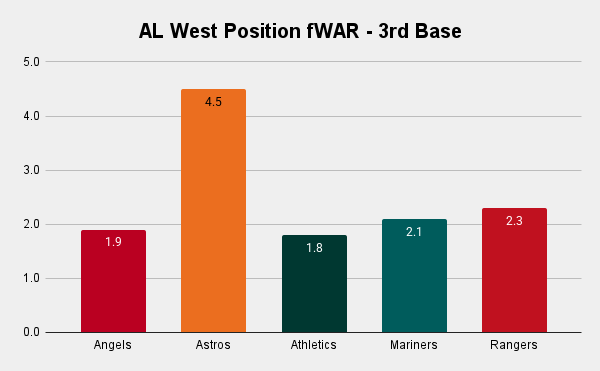
Carlos Correa racked up 1.5 fWAR in 220 plate appearances for the Astros last season, and Fangraphs picks up right there, projecting him at 3.6 for the full season and an additional 0.9 at the position from Paredes, making the Astros far and away the class of the division at this position.
Remember, a trade of Paredes will not only cost the Astros the 0.3 Paredes is allotted at that position, but another 0.9 at 3rd base.

Left Field
With Yordan scheduled to mostly DH and Altuve to mostly play second base, this is an intriguing position for Houston.
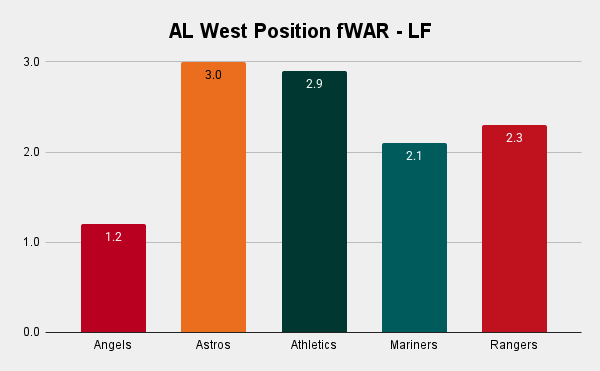
Fangraphs places the playing time thusly: Jesus Sanchez, Alvarez, Zach Cole, Altuve, Zach Dezenzo and Taylor Trammell.
That’s less than the 11 left fielders used last year, but it is still a rotating mish-mash of talent and prospects that somehow projects to be the best in the division (barely).
Centerfield
Jake Meyers, right? Right?
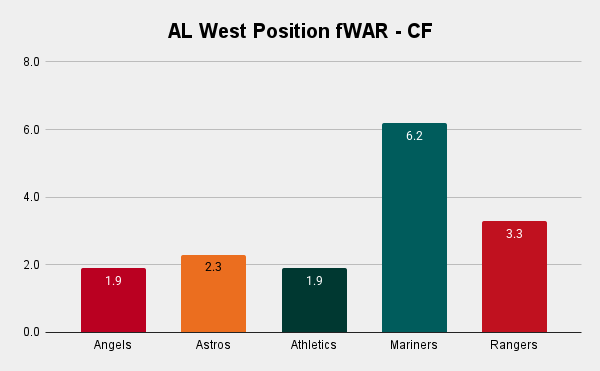
Regression is expected from Meyers, and word has it that Zach Cole will be given an opportunity here, too, along with Matthews.
I’ve been vocal about the fact that the Astros need more power out of this position, even at the expense of average.
Julio is obviously the class of this position in the division, and it’s not close.

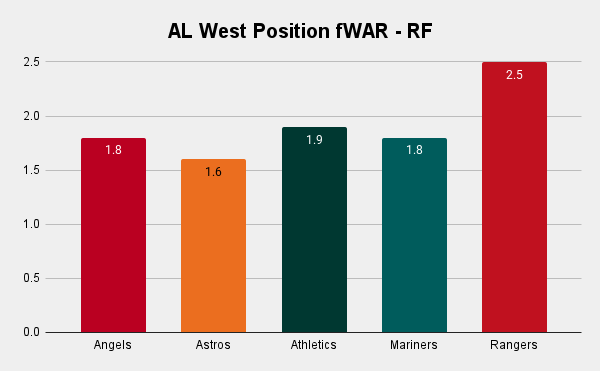
Right Field
Last season started with so much promise, which is crazy to say after trading away the newly minted $60 million dollar man.
Alas, the rookie wall hit, and Cam Smith didn’t. At all down the stretch.
It’s shocking to see the Astros worst in the division at this position, but it’s a real question mark for me headed into the season.
The projections have Smith getting most of the reps with most of the characters vying for time in left vying for time here - Sanchez, Cole, Dezenzo, and Trammell.
More importantly to me, those projections see no upside from Smith, projecting a 1.0 fWAR, the same as he finished last season with.
Designated Hitter
Yordan has to stay healthy, and if he does, the Astros have a chance to contend.
Writers can pick and choose what years to analyze and what injuries to include, but there have been 5 full seasons since the pandemic, and Yordan played 114 games in one of them and 48 in another.
In the three “healthy” years, he averaged 142 games.
Another way to look at it: in 5 years, he’s played in 588 games (72.7%) and missed 221 (27.3%).
That’s an average of 118 games a season.
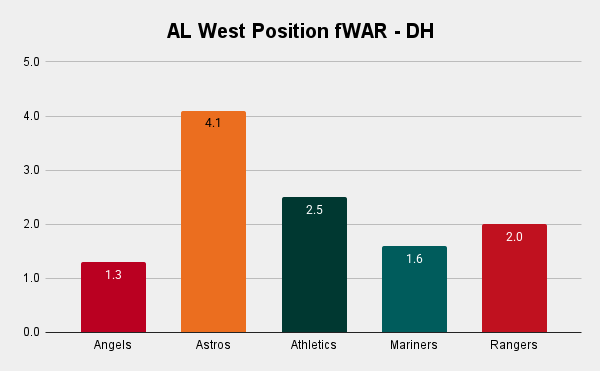
I’ve estimated that last year’s injury cost the Astros 9 games, a playoff spot and the AL West crown.
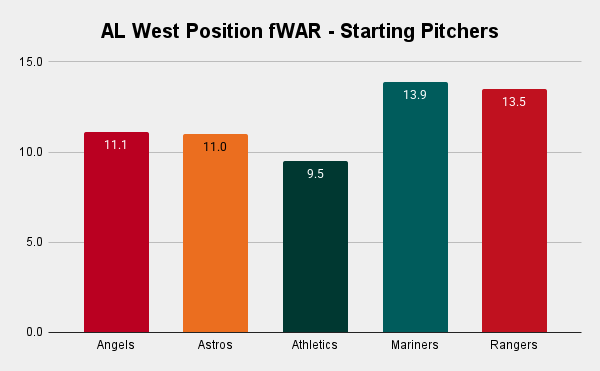
Starting Pitchers
The Rangers’ move to acquire Mackenzie Gore made this a two-team race, and the shock for me was the Angels nipping the Astros in the projections. Your rotation being comparable to the Angels in 2026 is not a good thing.
Scoring runs in Seattle and Arlington will be tough in 2026.
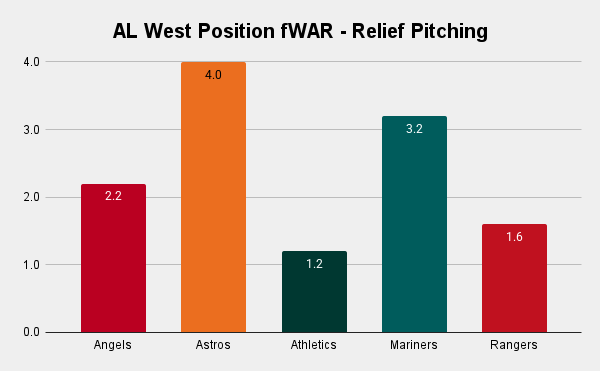
Relief Pitchers
Bullpens are not a strong suit of the AL West, but by this measure, the Astros are tied for fifth in the league.
Houston has three solid arms (Josh Hader, Bryan Abreu and Bryan King) and hopefully can find other pieces to fill the void.
Bullpens are notoriously volatile, so having three solid arms is an advantage, but WAR notoriously undervalues the reliever role, in my opinion.
Total
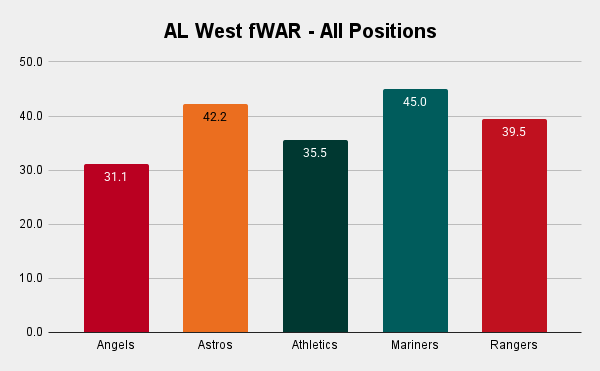
No one should be surprised by the numbers below, and as we stand today, I would favor the Mariners by 3-5 games over the Astros, with the Rangers coming in a game or two behind Houston.
I question the Astros rotation heading into the season, as do the projections, but I also question the outfield, as 0 of the 3 positions seem settled or what you would want from an MLB outfield.
Just a Piece of the Puzzle
Every team has its problems, as the Mariners appear vulnerable at some infield positions, and the Rangers will once again rely on their rotation to make it through with minimal injuries and hope for outsized contributions from a mostly anonymous bullpen.
These numbers are only projections and, at any rate, just a starting point, as regression, both positive and negative, becomes reality, and injuries become part of the daily grind of what makes a MLB season the masterpiece it becomes between mid-March and late September.
As always, thanks for reading!
Terrific Crawford Street Journal magazine cover, Marty! If you've shown it before, I'm just noticing it.....eye-catching and effective! I love the bar graphs, too. '26 looks to be one of those years we've become accustomed to, in the pre-championship years: A lot of moving pieces from inning to inning and game to game, based on match-ups! Challenges for the coaching staff!
It's a shame that we're still waiting for Jake to blossom, and it's clear he won't/can't. I was one of his biggest fans to succeed half-a-dozen years ago! And, here's hoping Altuve can get the feel again for around the bag on a more consistent basis!